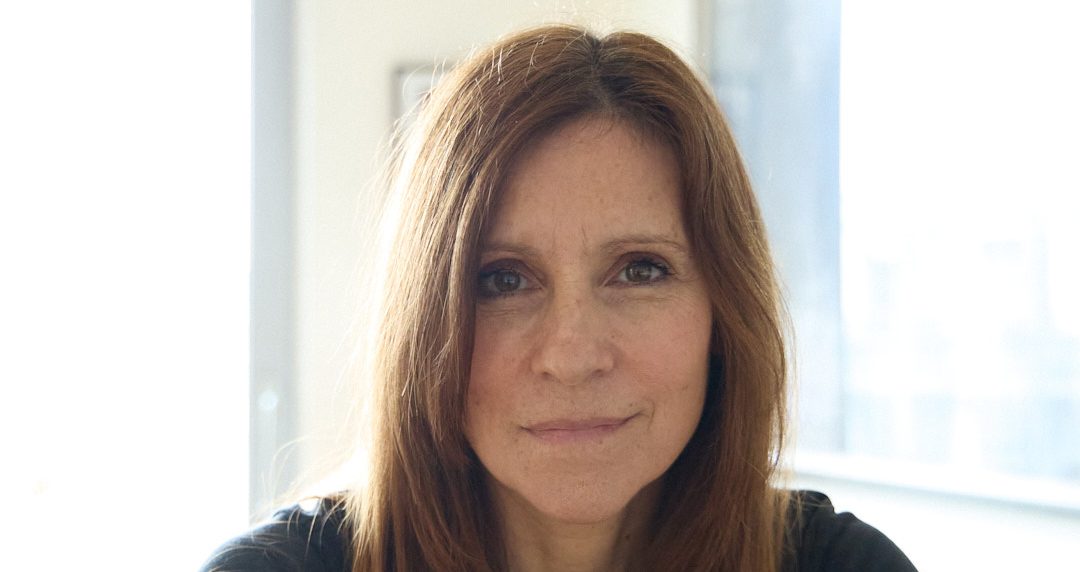
“Many people have told me that asking for help is a crucial component of success. All successful people do it apparently. I think if someone had told me that earlier in my career, I would have forced myself to adapt and become better at it.”
Director · Screenwriter · Producer · Script Supervisor · Editor | @laurenmclaughlin3

What pulled you into film and TV in the first place?
I was studying cultural anthropology at New York University in the early 90s when I caught the Madonna documentary, Truth or Dare. It intrigued me that the filmmaker Alek Keshishian, with no advanced degree in anthropology or sociology, was able to capture something so relevant about the times we were living in. As I walked the long journey from Harlem back downtown to the East Village, I made up my mind to drop out of graduate school and pursue a career in documentary filmmaking. I was twenty-three years old and prone to massive over-confidence when making life-changing decisions. But it worked. My first job was as an editor’s assistant on a documentary about the gentrification of Hoboken, New Jersey. It was shot on 16 mm film and I was responsible for organising clips and splicing them together into reels using a Steenbeck, which I’d learned how to use in the one film production course I took at NYU, the legendary Sight and Sound. From there, I took whatever film crew job I could find, working mostly on music videos, commercials, and very low budget indie films. I worked in any department that would have me, art, wardrobe, A.D., production office. I didn’t care. I had found my people.
What do you think the industry gets most wrong about women like you?
I think the film industry, despite efforts to eliminate gender prejudice, still has a strong male bias. Women’s screenplays are considered “women’s stories,” whereas men’s screenplays are just “stories.” The majority of equity financiers are still men and, while I do not believe they are engaged in any conscious effort to discriminate against female filmmakers, I think they are subject to the same ordinary cultural biases that afflict society as a whole. Thus indie films maintain their male bias. Women are still very much swimming upstream. Here’s an anecdote to illustrate this phenomenon. In 2007 I was tapped to write a lady mobster film for a major studio. I spent the weekend drafting a treatment and some sample pages to show them what I could bring to the project. That same weekend both Jodie Foster and Nicole Kidman starred in films that did not perform particularly well at the box office, The Brave One and The Invasion, respectively. Because these were both female-led movies, the studio behind the lady mobster film pulled the plug because, say it with me now, “women don’t open films.” Now, in that same period a number of male-led movies also underperformed: The Assassination of Jesse James by the Coward Robert Ford starring Brad Pitt, Shoot ’em Up starring Clive Owen, In the Valley of Elah starring Tommy Lee Jones, to name a few. But no one, not a single film executive ever, said the words: “Men don’t open films.” I think what the industry doesn’t get is that audiences sincerely do not care if the lead is female or male. They want great stories. But because executives and financiers are always looking for a way to predict and make rational something that is fundamentally unknowable and therefore unpredictable, they will reach for whatever post-facto rationalization they can find. Gender is one of those things.
What does success mean to you?
I am happiest when I’m making films. I like every part of the process, writing, prepping, shooting, editing. The only parts I don’t like are fund-raising and self-promotion, arguably the two most important components of success. So for me success means the ability to make film after film because someone is financing them and someone else is promoting them. To arrive at this state, I have had to override my horror at asking people for money, as well as finding partners who can help find available funding. I don’t believe in the philanthropic side of film funding (BFI, etc.) so I’m strictly working with equity financiers and sales and distribution companies. When I’ve got three films financed and lined up ready to shoot, I’ll feel successful.
What are you most proud of that most people don’t know about?
I have made a habit of leaving careers at their height. I left my film career in 2001 when I was Vice President of Production at Lionsgate Films and had just produced American Psycho and Buffalo ’66. I left to write novels with absolutely no idea how the publishing industry worked. I learned very quickly how hard it is to find a publisher. But I succeeded eventually. The day my literary agent called to tell me that she had three offers on my first novel, Cycler, was one of the proudest days of my life. After a short bidding war, I sold it and a sequel for a sizable advance. I had left a secure and lucrative career to pursue something completely unfamiliar because that was where my creative impulses led me. And it had worked. Eighteen years later, I left the world of publishing to return to filmmaking. Only now I lived in a new country, the UK, and the industry had changed dramatically. Not wanting to return to producing, I retrained as a script supervisor and caught the tail end of the streaming boom, to rise quickly from assistant script supervisor on low budget gaming films, to main unit script supervisor on big budget action films. I had to swallow some pride to go from indie producer of culturally significant films like American Psycho to assistant script supervisor on a video game I’d never heard of. But it too worked. It was the start of phase two of my film career, which would lead me to directing.
What keeps you going when the industry makes it hard?
I’m fortunate to have a variety of income streams. As a multi-hyphenate I can work as a script supervisor, story editor, screenwriter, director, producer, and editor. I also work across different media, feature films, series, commercials, and fashion films. This makes it easier to earn a living. Also, I’m not intimidated by the grim state of the industry right now. Rather I see it as an opportunity. Working in low budget filmmaking in New York City in the 90s exposed me to great uncertainty and constant flux between flush times and slow times. That period also gave rise to the great boom in independent filmmaking, culminating in The Blair Witch Project, American Psycho, and many others. The film industry constantly goes through periods of uncertainty and chaos. The birth of cable TV, home video, then streaming all disrupted previous business models. People panicked. In the 90s people thought Blockbuster Video was going to kill theatrical. It didn’t. What makes this period of disruption different is that it’s lasting longer than previous ones. Usually the industry settles down into a new normal eventually. But now there is no new normal so financiers are essentially greenlighting into the great unknown. What this means is that filmmakers have to be nimble and resourceful. I feel very comfortable there as I pride myself on knowing how and where to spend money to put value on the screen. The challenge for me is figuring out the distribution landscape so that I can budget projects accordingly and that’s what I’m working on.
What is one piece of advice you wish you had heard earlier?
I was fortunate to be at Lionsgate in the early days, before it was even called Lionsgate. We financed our films through foreign pre-sales. So my job was to find projects, budget them, put together potential cast lists then present them to our foreign sales team. They’d tell me how much they could reliably sell a project for in the foreign market, and if the math added up, we’d greenlight and go. I never had to ask anyone for money. Now I’m in the unhappy position of having to ask people for money, which I hate. Many people have told me that asking for help is a crucial component of success. All successful people do it apparently. I think if someone had told me that earlier in my career, I would have forced myself to adapt and become better at it. Now that I’m older it’s very hard to overcome my fear of asking for help. I see myself as a helper, not one who seeks help and I don’t know if there’s enough time to learn this skill. I believe that if I don’t succeed as a filmmaker, this will be the reason.
Anything else you’d like to share?
I returned to the film industry in 2020 when my daughter was twelve. She had just started secondary school and the reduced parenting responsibilities made returning to filmmaking seem plausible. I joined some Facebook groups for London-based filmmakers, introducing myself and writing about my background. Only women responded. I then noticed that there was a kind of loose, unofficial network of women returning to work after raising kids who were incredibly helpful and generous with their time and advice. I wound up working with a number of them in various capacities. It taught me this important lesson: if you want to find the most hard-working, resourceful, get-things-done people for your project, find women returning to work after raising kids. They’ve been through a lot. They know how to prioritise, they’re hungry for creative work, and they have no time for nonsense. I think women in this category are often overlooked and it’s a big mistake. When I get my production company up and running, I am going to ensure that at least 50% of my crew is female. To find out more about my work, you can follow me on insta @laurenmclaughlin3, Twitter @laurenmcwoof, Facebook @lauren.mclaughlin.books, or my website: laurenmclaughlin.net.